
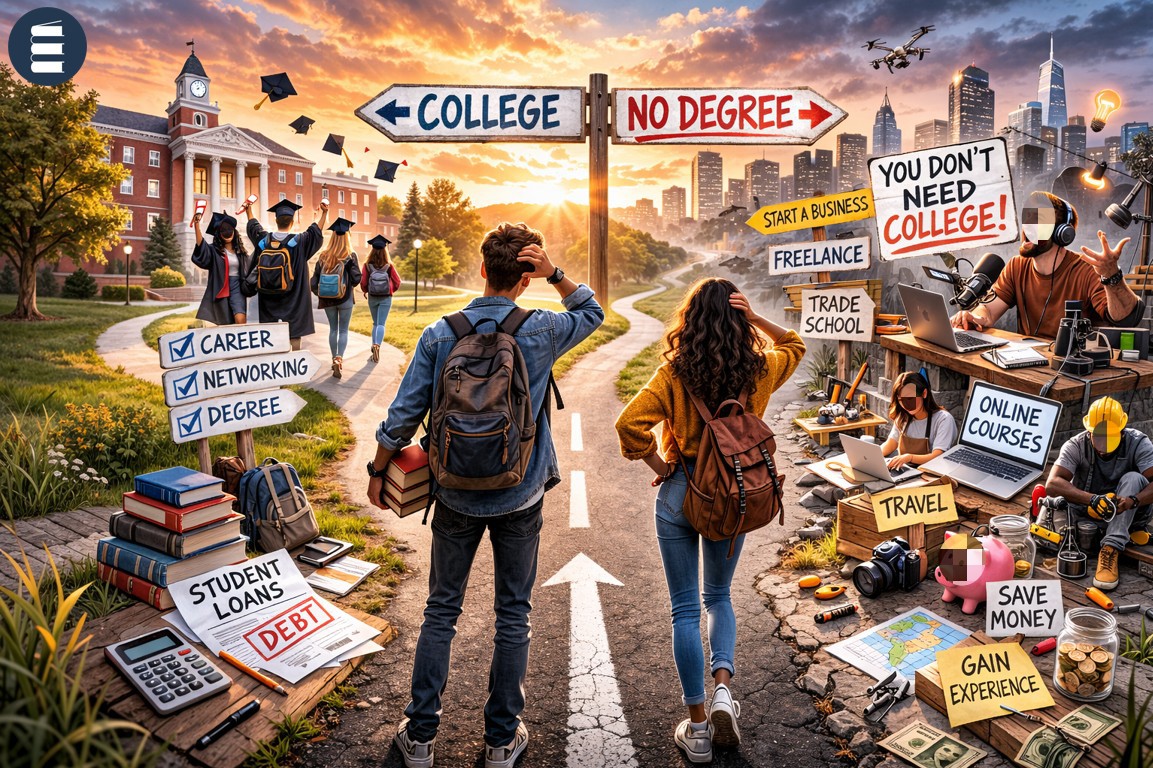
Scroll through TikTok or YouTube long enough and you’ll hear it:
“College is a scam.”
“Just start a business.”
“Learn a skill online.”
“University is outdated.”
The anti-college narrative is loud, confident, and viral.
And honestly? It exists for a reason.
Tuition costs have risen in many countries. Graduates struggle with debt. Some degree holders work jobs that don’t require degrees. Meanwhile, a 19-year-old with a laptop can build a SaaS tool, trade markets, edit videos, or launch a brand from their bedroom.
It makes for great content.
But here’s where it gets interesting.
The data tells a story that isn’t nearly as dramatic.
The Income Reality
Across most developed and emerging economies, people with higher education degrees still earn more on average over their lifetime than those without.
Not in every case.
Not for every major.
Not instantly.
But statistically? The gap remains.
The difference becomes even more pronounced in fields like:
Medicine
Engineering
Law
Finance
Technology
Specialized research
Degrees in these areas are not decorative. They are gateways. You cannot “YouTube your way” into being a surgeon. And if someone tells you otherwise, run.
At the same time, degrees in oversaturated or poorly aligned programs may not deliver the same return.
So the real issue is not “college vs no college.”
It’s what, where, and why.
The Survivorship Bias Problem
Social media amplifies outliers.
You’ll see:
The 21-year-old crypto millionaire
The high school dropout who built a $10M brand
The self-taught developer working remotely from Bali
What you don’t see?
The thousands who tried the same path and quietly went back to employment.
The internet celebrates exceptions. Data measures patterns.
Both are real. But they are not the same thing.
Skills vs Credentials Is a False War
The loud debate frames it like a battle:
Skills vs Degrees.
Entrepreneurship vs Employment.
Freedom vs Structure.
Reality is more blended.
Many successful founders have degrees.
Many high earners without degrees eventually invest heavily in structured learning.
Many degree holders build businesses later.
Education is evolving. It’s no longer confined to lecture halls. But dismissing formal education entirely ignores the infrastructure it provides:
Networks
Accreditation
Signaling
Research access
Structured progression
In many industries, that signaling still matters.
A lot.
The Global Context
In some regions, access to higher education still dramatically changes life trajectory.
In developing economies especially, a university qualification can:
Unlock international mobility
Increase employment stability
Provide professional licensing
Expand earning capacity across generations
The anti-college narrative often originates in countries where higher education saturation is already high.
The global picture is more nuanced.
So What’s Actually Happening?
Here’s the more honest framing:
College is not a guaranteed success machine.
Dropping out is not a guaranteed shortcut to wealth.
The labor market is changing faster than institutions.
Degrees alone are no longer enough.
Skills alone are sometimes not enough either.
The smart strategy?
Alignment.
Choose education paths tied to real demand.
Layer formal education with practical skills.
Understand the economics of your field before committing years and money.
Treat education as leverage, not identity.
The Complicated Truth
Anti-college content thrives because frustration is real.
But data shows that higher education still correlates with higher lifetime earnings and stability in most structured professions.
The mistake is assuming there’s a universal answer.
Education is no longer binary. It’s strategic.
The question isn’t:
“Is college worth it?”
The better question is:
“What is the return on this specific path for this specific person in this specific economy?”
That’s not viral.
But it’s honest.